“Growth marketing” gets used as a buzzword for almost anything with a dashboard. Underneath the hype is a real and useful discipline: a way of working that treats every stage of the customer journey as something you can measure, test and improve. Traditional marketing, meanwhile, is not the dinosaur some growth blogs make it out to be. This guide explains what each approach actually is, where each one wins, and how to combine them into a system that produces growth you can sustain rather than spikes you cannot repeat.
Key takeaways
- Traditional marketing optimizes campaigns for reach and awareness; growth marketing optimizes the full customer lifecycle through continuous experiments.
- The AARRR framework (Acquisition, Activation, Retention, Referral, Revenue) helps you find the stage that is actually limiting growth.
- Good experimentation starts with a written hypothesis and a prioritization model such as ICE or RICE, and ends with a documented learning.
- Retention and lifetime value decide whether acquisition spend compounds or leaks away.
- Brand and traditional channels still matter for demand creation, trust and pricing power. The best programs use both.
Defining the two approaches
Before comparing them, it helps to define both terms precisely, because most arguments about “growth vs. traditional” are really arguments about different definitions.
Traditional marketing
Traditional marketing, in the sense most people mean, is campaign-centric. A team defines a target audience, develops a message and creative concept, buys media (TV, radio, print, out-of-home, and increasingly digital display and social), runs the campaign for a set flight, and evaluates it against reach, frequency, awareness and sales lift. The work is planned in advance, often annually or quarterly, and creative is developed to a high finish before launch. The strengths are obvious: it builds memory structures in a broad audience, shapes perception at scale and creates the demand that other channels later harvest.
Growth marketing
Growth marketing is lifecycle-centric and experiment-driven. Instead of asking “how do we promote this campaign?”, it asks “which stage of the customer journey is limiting revenue right now, and what is the fastest reliable way to improve it?” The answer might be a paid acquisition test, but it could just as easily be a change to onboarding, pricing presentation, a referral incentive or a win-back email. Growth marketers work in short cycles, measure outcomes at the user or account level, and keep a running backlog of hypotheses ranked by expected value.
The key distinction is not digital vs. offline. A TV campaign can be run with growth discipline (geo-split tests, clear hypotheses, incrementality reads), and a Google Ads account can be run like a 1990s media plan (set it, forget it, report impressions). The difference is the operating model.
The AARRR framework: pirate metrics in practice
The most widely used growth model is AARRR, introduced by investor Dave McClure and nicknamed “pirate metrics” because of how the acronym sounds read aloud. It breaks the journey into five stages, each with its own metrics and owners.
- Acquisition. How people first find you: paid search, paid social, organic search, partnerships, events. Measure cost per visitor or lead by channel and, more importantly, the quality of what each channel brings in.
- Activation. The first moment a new user experiences real value. For a SaaS product that might be completing setup; for an e-commerce brand, a first purchase; for a service business, a booked consultation. Define one clear activation event per business model.
- Retention. Whether people come back, reorder or renew. Track cohort retention curves rather than a single blended rate, so you can see whether newer cohorts behave better or worse than older ones.
- Referral. Whether customers bring others. This includes formal referral programs, reviews, word of mouth and shared content.
- Revenue. How much value each customer generates over time, including average order value, upgrade rate and lifetime value (LTV).
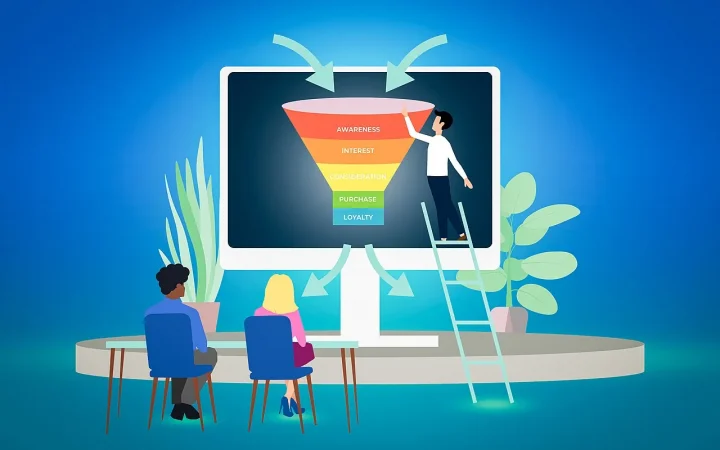
The practical power of the framework is diagnostic. If acquisition looks healthy but activation is weak, more ad spend just pours more people into a leaky bucket. If retention is strong but acquisition is expensive, referral programs or better targeting may be the lever. Many teams add a sixth stage, Awareness, at the front; that addition is a useful bridge to the brand work discussed later. For a stage-by-stage view of channels and messages, see our guide to building a full-funnel marketing strategy.
Pro tip: Pick one “North Star” metric that reflects delivered customer value, such as weekly active accounts or repeat purchases per customer, and map each AARRR metric to it. This stops teams from optimizing a stage in a way that hurts the whole.
Experimentation: hypothesis, test, learn
Experimentation is the engine of growth marketing. It is also where many teams fall down, because “we tried a new ad” is not an experiment. A real experiment has a written hypothesis, a defined metric, a planned sample and a decision rule set before the test starts.
The experiment loop
- Observe. Use analytics, session recordings, customer interviews and sales call notes to identify where users struggle or drop off.
- Hypothesize. Write it down in a consistent format: “Because we observed [evidence], we believe that [change] for [audience] will cause [outcome]. We will know this is true when [metric] moves by [minimum meaningful effect].”
- Prioritize. Score the backlog (see below) and pick the highest-value tests your traffic can support.
- Test. Run a controlled test: an A/B test on a landing page, a holdout group in email, a geo split for media, or a campaign experiment inside the ad platform.
- Learn. Record the result, whether it won, lost or was inconclusive, along with why you think it happened and what you will test next. Losing tests that teach you something are not failures.
ICE and RICE prioritization
A backlog of fifty ideas is useless without a way to rank them. Two scoring models are common:
- ICE (popularized by Sean Ellis) scores each idea on Impact, Confidence and Ease, typically 1 to 10 each. It is fast and good for small teams.
- RICE (developed at Intercom) scores Reach, Impact, Confidence and Effort, then calculates (Reach x Impact x Confidence) / Effort. It adds discipline by forcing you to estimate how many people a change will actually affect.
For example, an idea to rewrite the checkout page headline might have high reach (every buyer sees it) and low effort, while a new referral program might have high potential impact but low confidence and high effort. Scoring makes those trade-offs explicit instead of leaving them to whoever argues loudest in the meeting. Neither model is precise; their value is consistency.
Watch out: Low-traffic tests are where false winners come from. If a landing page gets a few hundred visits a month, a classic A/B test may take far too long to reach a reliable result. Test bigger, bolder changes, use higher-funnel metrics, or rely on qualitative research until volume grows.
Why retention and LTV decide everything
The single biggest difference in mindset between campaign marketing and growth marketing is what happens after the first conversion. A campaign often ends at the sale. Growth marketing treats the sale as the beginning of the economic relationship.
Lifetime value is the total gross margin a customer generates over their relationship with you. Customer acquisition cost (CAC) is what you spend to win them. The ratio between the two, and how long it takes to earn back CAC (the payback period), determines how aggressively you can afford to acquire. A business with strong retention can outbid competitors for the same customers and still be more profitable. We cover the math in detail in our article on ROAS, ROI and CAC.
Practical retention levers
- Onboarding. Shorten the path to the activation moment. Remove steps, pre-fill what you can and send timely guidance.
- Lifecycle messaging. Trigger email, SMS or in-app messages from behavior (abandoned cart, inactivity, replenishment timing) rather than a fixed calendar.
- Product and service quality. No campaign fixes a product people do not want to use again. Feed churn reasons back to product and operations.
- Customer segmentation. Identify your highest-value cohorts and build lookalike or similar-audience targeting around them, so acquisition brings in more of the customers who stay.
- Win-back programs. Lapsed customers already know you; reactivation can be cheaper than acquiring new customers, though you should test this for your own business rather than assume it.
Where brand and traditional marketing still matter
Growth teams sometimes dismiss brand spend because it is harder to attribute. That is a measurement problem, not proof that brand does not work. Several things are difficult or impossible to achieve with purely performance-driven activity:
- Demand creation. Performance channels like branded search mostly capture demand that already exists. Someone had to create that demand. Broad-reach video, audio, out-of-home and sponsorships put your brand in the minds of people who are not in market yet.
- Trust and conversion efficiency. A familiar brand typically converts better on the same ad, which lowers your effective acquisition cost. You will see the benefit in performance metrics even though the cause sits elsewhere.
- Pricing power. Strong brands can hold price instead of competing purely on discounts.
- Consistency. Distinctive brand assets (colors, voice, characters, sonic cues) make every performance ad work harder because people recognize who it is from.
The answer is to measure brand activity with methods suited to it: geo-based lift tests, brand lift studies offered by ad platforms, branded search volume trends, and marketing mix modeling. Our guide to marketing attribution and incrementality explains how to set these up.
Growth vs. traditional marketing: side-by-side comparison
| Dimension | Traditional marketing | Growth marketing |
|---|---|---|
| Primary focus | Reach, awareness, perception | Full lifecycle: acquisition through revenue and referral |
| Planning cycle | Annual or quarterly campaign plans | Weekly or bi-weekly experiment sprints |
| Core metrics | Reach, frequency, awareness, brand lift | Activation rate, retention cohorts, CAC, LTV, payback |
| Creative process | Few high-production concepts | Many variants tested and iterated quickly |
| Channels | TV, radio, print, out-of-home, broad digital | Paid search and social, lifecycle email, product, referral, CRO |
| Measurement | Brand studies, media mix models | Controlled experiments, cohort analysis, incrementality tests |
| Team structure | Channel and creative specialists, agencies of record | Cross-functional pods: marketing, data, product, engineering |
| Biggest strength | Creates future demand and trust at scale | Finds and fixes bottlenecks quickly with evidence |
| Biggest risk | Slow feedback, hard to tie to revenue | Short-termism and over-harvesting existing demand |
Building a growth team and operating process
You do not need a large headcount to work this way. You need clear ownership, access to data and a repeatable rhythm.
Roles to cover
- Growth lead. Owns the North Star metric, the backlog and prioritization.
- Channel specialists. Paid search, paid social and lifecycle marketing experts who run and analyze channel tests.
- Analyst or analytics engineer. Keeps tracking reliable, builds dashboards and reads test results honestly.
- Designer and copywriter. Produce variants quickly enough to keep the testing cadence going.
- Developer access. Landing pages, forms and product changes need engineering time. Without it, the backlog stalls.
In smaller companies one person may cover several roles, or an agency may provide the specialist and analytics capacity while an internal owner keeps strategic control.
A simple weekly rhythm
- Monday: metrics review. Look at the AARRR dashboard. Which stage moved? Which test results are ready?
- Midweek: backlog grooming. Add new hypotheses from data, customer feedback and sales. Re-score with ICE or RICE.
- Launch window. Ship the next tests with tracking verified before traffic arrives.
- Friday: learning log. Document results and decisions in a shared repository so knowledge survives staff changes.
Common mistakes to avoid
- Calling tests early because the first few days look good.
- Running so many simultaneous tests on the same audience that results contaminate each other.
- Optimizing for cheap leads that sales cannot close.
- Ignoring tracking quality. Every decision is only as good as the data behind it.
How to combine both into one growth system
The most resilient companies do not choose a side. They run brand activity that creates demand and growth processes that convert and keep that demand efficiently. Here is a practical way to combine them:
- Audit the funnel. Map each AARRR stage, its current metrics and its owner. Identify the constraint.
- Set a portfolio. Decide deliberately how much budget goes to demand creation versus demand capture, and revisit that split based on test results rather than habit.
- Apply experiment discipline everywhere. Even a brand video campaign can be run in test and control regions to estimate lift.
- Share learnings across teams. Messages that win in paid social tests can inform brand creative, and brand positioning can sharpen performance ad copy.
- Measure with multiple lenses. Combine platform reporting, analytics attribution, incrementality tests and mix modeling. No single source tells the full story.
If you want a structured starting point, our Growth Marketing Strategy Sprint audits your funnel, builds a prioritized experiment backlog and sets up the measurement you need to run it.
Turn your funnel into a growth system
Alluka LLC helps teams find the real bottleneck in their customer journey, prioritize the experiments that matter and measure results honestly across paid and owned channels. Let’s look at your numbers together.
Growth marketing is not a replacement for marketing fundamentals; it is a more rigorous way of applying them across the entire customer lifecycle. Keep the brand building that creates demand, add the experimentation discipline that improves every stage, and let retention and lifetime value tell you how hard you can push.