Most marketing programs are not short of activity. They are short of connection. The awareness campaign runs on one set of goals, the search campaigns on another, the email team on a third, and nobody can say how a person moves from first impression to loyal customer. A full-funnel strategy fixes that by planning every stage as part of one system, so each touchpoint does a specific job and hands the customer to the next. This guide shows you how to build one, step by step.
Key takeaways
- Plan five stages, not three: awareness (TOFU), consideration (MOFU), conversion (BOFU), retention and advocacy.
- Each stage needs its own channel mix, message, offer and KPI. Judging awareness campaigns on last-click sales sets them up to fail.
- Budget allocation should follow your demand situation, sales cycle and test results, not a generic percentage rule.
- Audience sequencing and remarketing connect the stages so prospects get the next relevant message instead of the same ad repeatedly.
- Diagnose leaks stage by stage. The fix for weak conversion is rarely more top-of-funnel spend.
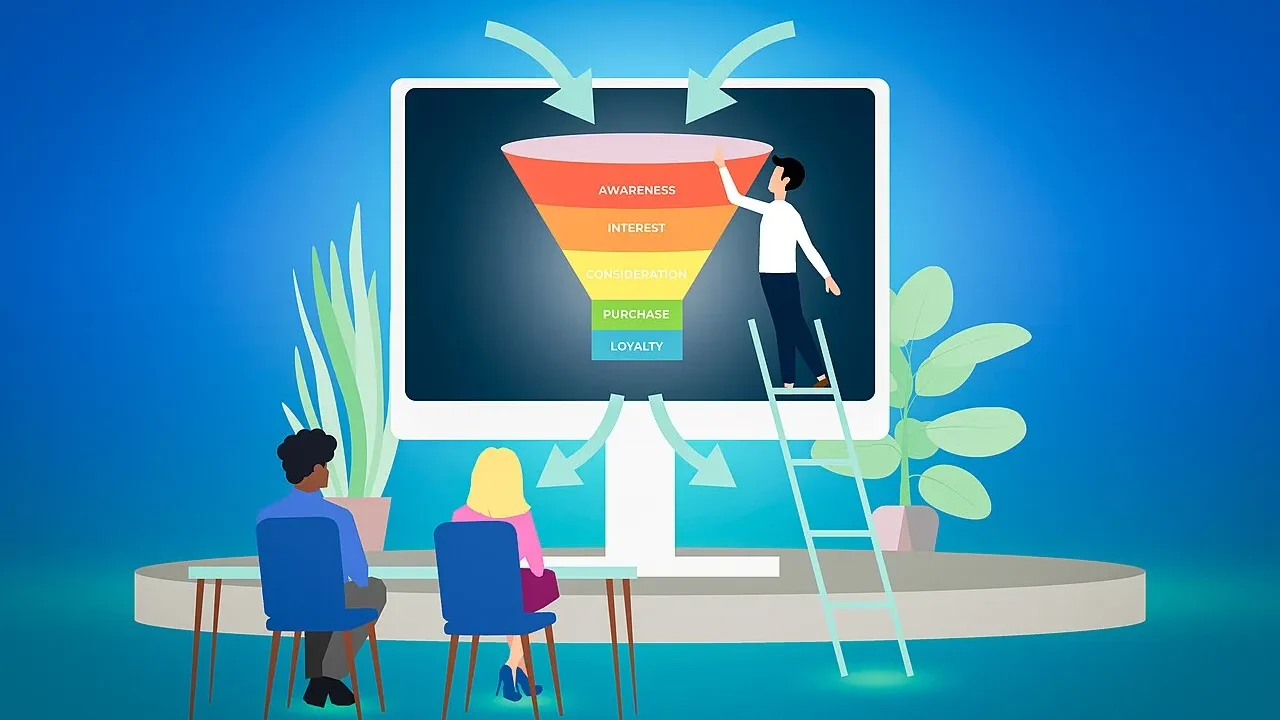
The five stages of a modern funnel
The classic funnel has three bands. A complete strategy adds two more after the purchase, because that is where profit and word of mouth are made.
- Top of funnel (TOFU) – awareness. People who do not yet know you, or do not yet know they have the problem you solve. The job is to earn attention and be remembered.
- Middle of funnel (MOFU) – consideration. People who have engaged in some way: watched a video, visited the site, followed your account, downloaded a guide. The job is to build understanding and trust.
- Bottom of funnel (BOFU) – conversion. People actively evaluating or ready to buy. The job is to remove friction and give them a reason to act now.
- Retention. Customers who have bought once. The job is to deliver value, drive repeat purchase or renewal, and reduce churn.
- Advocacy. Satisfied customers who can recommend you. The job is to make referring, reviewing and sharing easy and rewarding.
Real journeys are messy. Someone may search your brand name the first time they hear it, or bounce between consideration and conversion for weeks. Treat stages as levels of intent and relationship, not as a strict sequence, and the model stays useful.
Channels and messages for each stage
The most common mistake is running the same message everywhere. A cold audience does not care about your 15% discount; a ready-to-buy prospect does not need your brand story again. Match the message to the mindset.
TOFU: earn attention
Typical channels: short-form video on TikTok, Instagram Reels and YouTube; connected TV and online video; broad-audience Meta campaigns; programmatic display and audio; podcasts; organic social; PR and partnerships; educational search content.
Message: the problem, the outcome, the category and why you are different. Lead with the customer’s world, not your feature list. Use distinctive brand assets so people remember who the ad came from.
MOFU: build consideration
Typical channels: remarketing on social and display, YouTube and Demand Gen campaigns, non-brand search for problem and solution queries, email nurture, webinars, comparison content, LinkedIn for B2B.
Message: proof and specifics. How it works, who it is for, how it compares with alternatives, what real customers say, what objections are unfounded.
BOFU: convert
Typical channels: branded and high-intent search, Shopping and Performance Max for e-commerce, cart and form abandonment remarketing, sales follow-up, retargeting of pricing-page visitors.
Message: clarity and urgency. Price, guarantee, delivery or onboarding timeline, risk reversal, a clear call to action. Our landing page CRO tactics matter most here.
Retention and advocacy: keep and multiply
Typical channels: lifecycle email and SMS, in-app messaging, customer success outreach, loyalty programs, customer-list audiences on ad platforms, review requests, referral programs, user-generated content.
Message: getting more value, what to do next, recognition for loyalty and an easy way to share.
Matching offers to intent
An offer is what you ask people to do and what they get in return. The size of the ask should rise with intent.
| Stage | Ask | Example offers |
|---|---|---|
| TOFU | Watch, read, follow | Educational video, short guide, quiz, entertaining content, free tool |
| MOFU | Share an email, spend time | Webinar, case study, comparison guide, sample, product demo video, newsletter |
| BOFU | Buy, book, request a quote | Free consultation, trial, first-order incentive, bundle, guarantee, limited-time pricing |
| Retention | Buy again, renew, upgrade | Replenishment reminders, loyalty rewards, onboarding sessions, upgrade paths |
| Advocacy | Review, refer, share | Referral credit, early access, community membership, recognition |
For B2B and high-ticket services, be realistic about the BOFU ask. A cold LinkedIn audience rarely books a sales call from a first impression, while a prospect who has attended a webinar and read two case studies very well might.
Budget allocation logic
You will find plenty of articles quoting a “correct” split between funnel stages. Treat them with caution. The right allocation depends on your situation, and only your own data can confirm it. Instead of a fixed ratio, work through these questions.
- How much demand already exists? If many people already search for your category, capturing that demand with search and shopping is usually efficient. If your category is new or your brand unknown, you will need to fund demand creation, because there is little to capture.
- How long is your sales cycle? A short-cycle impulse product can see TOFU spend turn into revenue within days. A long B2B cycle needs patience and leading indicators to judge awareness and consideration spend.
- What is your cash position and payback target? A business that must recover acquisition cost quickly will lean toward high-intent stages. One with healthy margins and strong retention can invest further up the funnel.
- Is BOFU saturated? If adding budget to branded search or remarketing no longer brings proportional results, you are probably harvesting the same small pool. That is the signal to invest higher up.
- What do incrementality tests say? Holdout and geo tests reveal which stages create sales that would not have happened anyway. Shift budget toward proven incremental value.
Watch out: Last-click reporting systematically overstates bottom-of-funnel channels and understates awareness. If you allocate purely on last-click ROAS, budgets drift toward remarketing and branded search until growth stalls. Read our guide to attribution and incrementality before you rebalance.
KPIs for each stage
Each stage needs metrics that reflect its job. Use the stage KPI to optimize day to day, and use downstream business metrics to confirm the stage is actually feeding the next one.
| Stage | Primary KPIs | Health check metrics |
|---|---|---|
| TOFU | Reach, cost per thousand impressions, video view rate, thumb-stop or hook rate | Brand lift, branded search trend, new-visitor share, growth of engaged audiences |
| MOFU | Engaged sessions, content downloads, webinar registrations, email sign-ups, cost per engaged visitor | Lead-to-opportunity rate, return-visit rate, pricing-page visits |
| BOFU | Conversion rate, cost per acquisition, ROAS, cost per qualified lead | Close rate, average order value, refund or no-show rate |
| Retention | Repeat purchase rate, renewal rate, churn rate, cohort retention | Lifetime value, LTV to CAC ratio, payback period |
| Advocacy | Reviews collected, referral sign-ups, referral conversions, net promoter score | Share of new customers from referral, review rating trend |
The financial side of these metrics, including how to calculate profitable CAC, is covered in our article on ROAS, ROI and CAC.
Audience sequencing and remarketing
Sequencing is what turns a set of campaigns into a funnel. The idea is simple: what someone did last determines what they see next.
Build stage-based audiences
- Video viewers by depth (for example, people who watched at least half of a video) on Meta, TikTok and YouTube.
- Social engagers who interacted with your profile, posts or lead forms.
- Website visitors segmented by page type: blog readers, product or service viewers, pricing visitors, cart or form abandoners.
- Customer lists uploaded from your CRM (with appropriate consent), split into recent buyers, lapsed buyers and high-value customers.
Sequence the messages
- Cold audiences see a problem-and-outcome video.
- Engaged viewers see proof: testimonials, demonstrations, comparisons.
- Product or pricing visitors see the offer, objection handling and a clear call to action.
- Abandoners see a reminder with risk reversal, such as a guarantee or easy returns.
- Customers are excluded from acquisition ads and moved into onboarding, cross-sell and referral messaging.
Set windows and frequency deliberately
Match membership duration to your buying cycle: short windows for impulse products, longer windows for considered purchases. Cap frequency where the platform allows, and refresh creative before fatigue sets in. Always exclude recent converters from acquisition campaigns; paying to show “buy now” ads to someone who just bought wastes money and annoys customers.
Pro tip: Privacy changes have shrunk many website-based remarketing pools. Platform-native engagement audiences (video viewers, lead-form openers, profile engagers) and consented first-party lists are now often more reliable. Our guide to privacy-first retargeting covers this in depth.
Diagnosing funnel leaks
Once the funnel is mapped and tracked, you can find where it loses people. Work from the bottom up, because problems near the conversion point cost the most.
A stage-by-stage diagnostic
- Check tracking first. Before you blame a campaign, confirm that conversions, form submissions and key events fire correctly and match your CRM or order system.
- Compare stage-to-stage conversion rates over time. Calculate the rate at which each stage feeds the next (visitors to leads, leads to qualified, qualified to customer, customer to repeat). Look for the biggest drop relative to your own history.
- Segment the drop. Split by device, channel, campaign, landing page, geography and new versus returning. A leak that only appears on mobile or one traffic source points to a specific cause.
- Look at behavior. Heatmaps, session recordings and form analytics show where people hesitate or give up.
- Ask people. Short on-site surveys, sales call reviews and lost-deal interviews often explain what the numbers cannot.
Common leaks and likely fixes
| Symptom | Likely cause | First fix to try |
|---|---|---|
| High click-through, low conversion | Message mismatch between ad and landing page, slow page | Align headline and offer with the ad, improve page speed |
| Lots of leads, few sales | Targeting or offer attracts low-intent prospects | Qualify in the form, feed qualified-lead data back to ad platforms |
| Strong first purchase, weak repeat | Poor onboarding or product experience | Post-purchase sequence, fix product or service issues |
| Rising BOFU costs with flat volume | Remarketing pool exhausted | Invest in TOFU and MOFU to refill audiences |
| Good customers but few referrals | No prompt or incentive to share | Timed review requests and a simple referral program |
Putting it together: a 30-day build plan
- Week 1: map and measure. Document every current campaign and touchpoint by stage. Audit tracking and define one KPI per stage.
- Week 2: fill the gaps. Identify missing stages, typically MOFU nurture or post-purchase retention, and draft messages and offers for each.
- Week 3: build audiences and sequences. Create stage-based audiences, exclusions and remarketing flows across your main platforms.
- Week 4: launch and set a test plan. Launch the new structure and schedule at least one incrementality or holdout test to validate budget decisions.
Working through this with an outside team? Our growth marketing and paid media services are built around exactly this full-funnel structure.
Find out where your funnel leaks
Alluka LLC maps your channels, audiences and KPIs stage by stage, then builds the campaigns and tracking that move people from first impression to repeat customer. Book a call and we will walk through your funnel with you.
A full-funnel strategy is less about adding channels and more about giving every channel a clear job, a fitting message and a metric that reflects its role. Connect the stages with sequencing, measure them honestly and keep fixing the biggest leak, and the whole system becomes more efficient over time.